The $1.25 trillion deal that skipped the line: what the SpaceX-xAI merger reveals about antitrust blind spots
Elon Musk just closed the largest private company merger in history. SpaceX acquired xAI on February 2, 2026, in an all-stock deal valuing the combined entity at $1.25 trillion. The transaction used a triangular merger structure to keep xAI’s billions in debt at arm’s length, a tax-free share exchange to defer capital gains for investors, and a corporate architecture that may have allowed the entire deal to bypass federal merger review altogether.
That last part is the one worth sitting with.
Under a little-known HSR Act exemption for “intraperson transactions,” mergers between entities controlled by the same person may not require pre-merger notification to the FTC or DOJ. Musk controls both companies. If his lawyers relied on 16 CFR § 802.30, the biggest deal of the year may have closed without a single page of antitrust filing.
For any founder or executive who controls multiple companies, or who’s considering a deal with someone who does, this transaction is a case study in how far deal architecture can stretch before regulators push back. And whether they’ll push back at all.
The deal
SpaceX and xAI announced the merger on February 2 in a blog post from Musk, who described it as forming “the most ambitious, vertically-integrated innovation engine on (and off) Earth.” The numbers tell a different story than the rhetoric.
SpaceX was valued at roughly $1 trillion. xAI was valued at $250 billion, based on its most recent funding round in January 2026. The merger is structured as a share exchange: each share of xAI converts into 0.1433 shares of SpaceX stock, with xAI priced at $75.46 per share and SpaceX at $526.59.
Why a triangular merger?
In a typical merger, Company A absorbs Company B. The two entities become one. All of B’s assets, contracts, debts, and liabilities flow directly onto A’s balance sheet. For many transactions, that’s fine.
But when the target company carries billions in debt with change-of-control clauses, a direct merger can be catastrophic. Those clauses, which are standard in most large debt agreements, give lenders the right to demand immediate repayment if control of the borrower changes hands. A straight acquisition of xAI by SpaceX would likely have triggered those clauses, forcing repayment of billions before the deal even settled.
A triangular merger solves this. Here’s how it works in three steps:
Step 1: SpaceX creates a new, empty subsidiary (often called a “merger sub”). This entity exists solely for the transaction.
Step 2: The merger sub merges into xAI. The merger sub disappears. xAI survives, but it’s now a wholly-owned subsidiary of SpaceX.
Step 3: xAI’s shareholders receive SpaceX stock in exchange for their xAI shares (at a ratio of 0.1433 SpaceX shares per xAI share). Because xAI itself was never acquired by SpaceX directly, it wasn’t a change of control of xAI in the way most debt covenants define it. The entity persists. Its contracts remain intact. Its debts stay where they are.
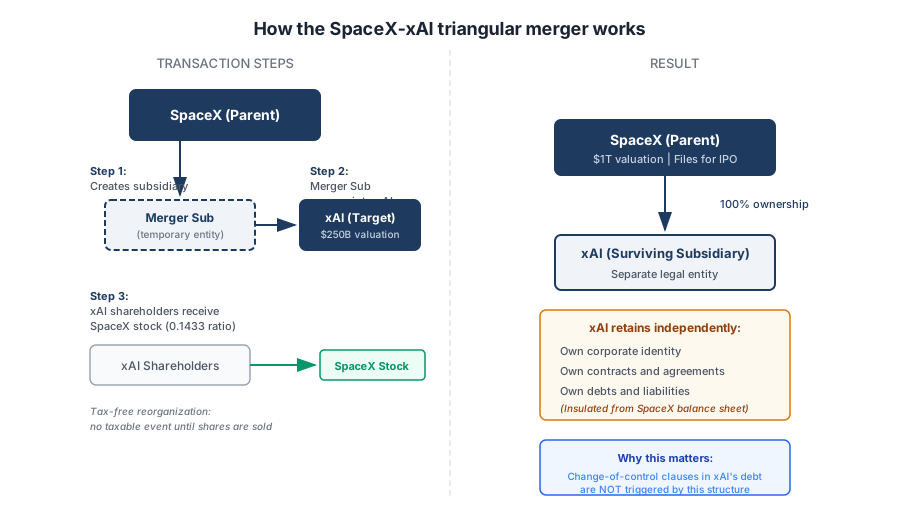
Reuters reported that this is exactly the approach SpaceX used. xAI survives as a wholly-owned subsidiary, keeping its own corporate identity, contracts, debts, and liabilities walled off from SpaceX’s balance sheet.
The deal was also structured as a tax-free reorganization under the Internal Revenue Code. xAI shareholders receive SpaceX stock without a taxable event until they actually sell.
Why does this matter for founders? Because the triangular merger isn’t exotic corporate law. It’s a standard M&A tool that any company can use. But most founders encounter it for the first time when their lawyers bring it up during a deal, and by then they’re already deep in negotiations. If you’re running a company with outstanding debt covenants, complex cap tables, or investors who need tax deferral on exit, this structure should be on your radar well before term sheets start circulating. Understanding it ahead of time gives you leverage in structuring the deal, not just reacting to what the other side proposes.
The HSR question: did this deal need federal approval?
Here’s where it gets legally interesting.
The Hart-Scott-Rodino Act requires parties to notify the FTC and DOJ before closing mergers above certain thresholds. For 2026, any deal above $133.9 million requires notification, and deals above $535.5 million require it regardless of the parties’ size. A $1.25 trillion deal obviously clears both.
But there’s an exemption. Under 16 CFR § 802.30, acquisitions where “the acquiring and acquired persons are the same person” are exempt from HSR filing requirements. The HSR rules define a “person” as an ultimate parent entity and all entities it controls, directly or indirectly (16 CFR § 801.1). If Musk, as a natural person, is the ultimate parent entity of both SpaceX and xAI, the acquisition is an intraperson transaction. No filing required.
Musk owns approximately 42% of SpaceX’s equity but holds 79% voting control. He holds a controlling stake in xAI. Under HSR rules, control generally means holding 50% or more of voting securities or having the contractual right to designate 50% or more of the board of directors. Whether Musk meets that threshold for both entities depends on corporate governance documents that haven’t been disclosed.
Neither SpaceX nor xAI has publicly confirmed whether an HSR filing was made. Neither company responded to press inquiries about regulatory review.
Exemption from filing is not exemption from antitrust law
This distinction matters, and it’s the part that should concern operators structuring their own deals.
Even if the intraperson exemption eliminates the HSR filing obligation, Section 7 of the Clayton Act still prohibits any acquisition “the effect of which may be substantially to lessen competition, or to tend to create a monopoly.” That prohibition applies regardless of whether an HSR filing was required or made.
The FTC, DOJ, and state attorneys general retain full authority to challenge any merger as anticompetitive after the fact. They’ve done it before. The XCL Resources case, where three crude oil producers paid a record $5.6 million civil penalty for pre-merger gun-jumping (announced January 2025, with final judgment entered February 2026), is a reminder that the agencies are watching. And they don’t need a pending filing to open an investigation.
So why would anyone rely on the intraperson exemption for a deal this large? Likely because the competitive overlap between SpaceX (launch services, satellite internet) and xAI (AI model development) is minimal today. The agencies typically challenge mergers between competitors or between companies in a buyer-supplier relationship. SpaceX and xAI don’t compete with each other in any existing market.
But that analysis depends on today’s market definitions. And those definitions are about to shift.
The vertical foreclosure problem nobody’s talking about
One week before announcing the merger, SpaceX filed with the FCC for authorization to launch up to one million satellites for an “orbital data center” constellation. The FCC accepted the application on February 5 and opened public comments until March 6.
If SpaceX builds orbital computing infrastructure and xAI becomes the primary customer for that infrastructure, the competitive picture changes. Rival AI companies, including OpenAI, Anthropic, Google, and Meta, currently depend on terrestrial data centers and cloud providers for compute. If SpaceX develops proprietary orbital compute that gives xAI a structural cost or capability advantage, those competitors may need access to SpaceX’s infrastructure to stay in the race.
That’s a textbook vertical foreclosure theory. The combined entity would control both the infrastructure layer (orbital data centers) and a major customer of that infrastructure (xAI’s AI models). The ability and incentive to deny or degrade access for rivals is exactly the kind of harm antitrust law is designed to prevent.
Our read: this theory faces real obstacles today. Space-based computing is unproven at commercial scale. The FCC filing doesn’t include deployment timelines or cost estimates. Courts are generally skeptical of blocking mergers based on speculative future markets. And competing alternatives exist; Blue Origin and others are developing orbital capabilities.
But the regulatory sequencing is telling. Filing the FCC application one week before announcing the merger means the orbital data center concept is already on the public record. If the combined company actually builds it, the antitrust agencies will have a much stronger case for post-consummation review. The question is whether they’ll act before the infrastructure is built, or wait until unwinding becomes impractical. History suggests the latter, which is the uncomfortable part.
National security: the CFIUS wild card
Antitrust isn’t the only framework in play. CFIUS, the Committee on Foreign Investment in the United States, reviews transactions that could threaten national security. It’s typically triggered by foreign acquisitions of U.S. companies. There’s no foreign buyer here.
But CFIUS has the authority to self-initiate reviews under 50 U.S.C. § 4565 if member agencies believe national security warrants scrutiny. And this deal has national security dimensions that are hard to ignore.
SpaceX holds classified government contracts. It operates Starlink, a satellite network that the U.S. military and intelligence agencies depend on for communications. xAI develops advanced AI systems capable of processing and analyzing the kind of data that flows through those satellites. Combining these capabilities under a single corporate parent creates risks that didn’t exist when the companies were separate.
There’s also the foreign investment angle. In 2025, a ProPublica investigation revealed that Chinese investors had been “quietly funneling tens of millions of dollars” into SpaceX through opaque Caribbean structures. Senators Warren and Kim raised concerns that these investors could gain access to nonpublic information about SpaceX’s contracts and supply chain.
If CFIUS does intervene, the most likely outcome isn’t blocking the deal. It’s mitigation conditions: strict personnel separation between SpaceX’s satellite operations and xAI’s AI development, government-approved security officers, and regular compliance audits. Those conditions could seriously constrain how the combined company operates, and could limit the very synergies Musk is promising investors ahead of the IPO.
The fiduciary minefield
There’s one more dimension that matters for operators, and it might be the most relevant one for founders who aren’t planning trillion-dollar deals: the conflict-of-interest exposure.
When one person controls both sides of a transaction, corporate law imposes heightened scrutiny on the deal. This isn’t unique to Musk or to deals of this size. It applies any time a founder, CEO, or controlling shareholder stands on both sides of a transaction between entities they control. If you own 60% of Company A and 80% of Company B, and Company A acquires Company B, you’re negotiating with yourself. The law recognizes this and responds accordingly.
How the Musk conflict plays out
Musk owns roughly 18% of Tesla, 42% of SpaceX (with 79% voting control), and a controlling stake in xAI. His economic interests aren’t equally distributed across these entities. He holds a far larger percentage of xAI and SpaceX than he does of Tesla. When he set the share exchange ratio for this deal, valuing xAI at $250 billion and SpaceX at $1 trillion, the terms directly affected how much of the combined entity his various investor groups would own. Every dollar of value attributed to xAI rather than SpaceX benefits Musk’s xAI stake at the expense of SpaceX’s other shareholders.
That’s the core problem with controller transactions. The person setting the price has an incentive to tilt it toward whichever entity they own more of.
The Tesla shareholder lawsuit
Tesla shareholders aren’t waiting for regulators to act. The Cleveland Bakers and Teamsters Pension Fund filed a derivative action in Delaware Chancery Court alleging that Musk diverted Tesla resources, including Nvidia H100 GPUs originally allocated to Tesla’s AI training, to xAI. The complaint alleges that Musk used his position as CEO and controlling shareholder of Tesla to redirect corporate assets to a company where he held a larger personal stake.
The plaintiffs want Musk to disgorge his xAI stake and return it to Tesla. That’s a drastic remedy, but it’s the standard one when a fiduciary is accused of self-dealing.
The SpaceX-xAI merger didn’t resolve these claims. If anything, it complicated them. xAI executives reportedly told investors their goal is to develop AI for Tesla’s Optimus robot. Follow the money on that one. Tesla is building a humanoid robot. The AI that powers it may come from xAI, which is now a subsidiary of SpaceX. Tesla would presumably need to license that technology, paying SpaceX (and by extension, Musk’s larger SpaceX stake) for AI that was arguably developed using Tesla’s own diverted resources. Try drawing that on a whiteboard without the arrows forming a circle. Courts don’t love that kind of arrangement.
What “entire fairness” means for founders
Delaware law applies a standard called “entire fairness” when a controller stands on both sides of a transaction. Here’s what that means in practice.
Normally, business decisions by a board of directors get the benefit of the “business judgment rule,” which is a high degree of deference from courts. Directors are presumed to have acted in good faith. Plaintiffs have to prove they didn’t.
Entire fairness flips that presumption. When a controlling shareholder is on both sides of a deal, the controller must prove two things: fair dealing (was the process honest and arm’s-length?) and fair price (were the economic terms reasonable?). The burden of proof shifts to the controller. You’re guilty until proven innocent, roughly speaking.
This standard came out of cases like Weinberger v. UOP and was sharpened in the 2014 Kahn v. M&F Worldwide decision, which established that a controller can get back to the business judgment standard only by using both an independent special committee and a majority-of-the-minority shareholder vote. Both safeguards, not just one.
For founders, the practical lessons are concrete. If you control two companies and want to do a deal between them, you need an independent board committee on each side with its own legal and financial advisors. You need a third-party valuation (not just a fairness opinion from your regular banker, but genuine independent analysis). You need contemporaneous documentation of the negotiation process showing that the independent directors actually pushed back, asked hard questions, and had the power to say no. And if any of the entities involved have minority shareholders, a majority-of-the-minority vote provides an additional layer of protection.
Skip any of these steps and you’re exposed to litigation that can unwind the entire deal or force disgorgement of the gains. That’s what Tesla’s shareholders are seeking here. And based on the facts in the complaint, they have a real shot.
The IPO clock
All of this unfolds against a deadline. SpaceX is expected to file for an IPO as early as mid-2026, potentially in June, at a valuation exceeding $1.5 trillion. The offering could raise $50 billion or more.
The IPO filing will require extensive disclosure. The SEC’s S-1 registration statement will need to address the merger terms, related-party transactions, pending litigation (including the Tesla shareholder suit), and regulatory risk factors. If CFIUS imposes mitigation conditions, those go in the filing too.
The timing creates strategic pressure. Once SpaceX files its S-1, challenging the merger becomes politically and practically harder. The agencies would be disrupting a public offering that creates enormous wealth for existing shareholders, including employees and early investors. That’s not a legal barrier to enforcement, but it’s a practical one that any dealmaker should understand.
Securities lawyers say the merger is unlikely to delay the IPO. Because xAI may fall below the SEC’s “significant subsidiary” threshold, SpaceX may not need to include xAI’s full financials in the offering documents. That determination will depend on the relative size tests under Regulation S-X, Rule 3-05.
Practical takeaways
If you’re planning a transaction between commonly-controlled entities, or structuring any deal where one person holds influence on both sides, here’s what to have on your checklist:
-
Audit your own intraperson exemption exposure. If you control multiple entities and are considering transactions between them, have antitrust counsel confirm whether 16 CFR § 802.30 actually applies to your corporate structure. The exemption depends on control thresholds that may not be met.
-
Map your Clayton Act risk separately from HSR obligations. Exemption from HSR filing doesn’t immunize a deal from antitrust challenge. If your transaction has any competitive overlap or vertical relationship, prepare a substantive antitrust analysis regardless of whether a filing is required.
-
Review change-of-control clauses in all debt instruments before structuring any deal. The triangular merger structure exists specifically to avoid triggering these provisions. If your target carries serious debt, build this analysis into deal planning from day one.
-
Document your business rationale contemporaneously. If regulators review the deal months or years later, you want a paper trail showing legitimate business purpose, not just tax or structural optimization.
-
If you control both sides of a transaction, appoint an independent committee immediately. Delaware’s entire fairness standard requires proof of fair process and fair price. Independent directors, third-party valuations, and arm’s-length negotiation are essential.
-
Brief your board on CFIUS self-initiation authority. If your company holds government contracts, operates critical infrastructure, or has any foreign investment in its cap table, CFIUS can open a review without a filing. Know your exposure.
-
Factor IPO timing into your regulatory strategy. If a public offering is on the horizon, regulatory challenges become more disruptive. Front-load your compliance analysis rather than hoping the clock runs out.
What we’re watching
-
FCC public comment period on SpaceX’s orbital data center application closes March 6, 2026. Competitor objections could signal future antitrust theories if orbital compute becomes commercially viable.
-
SpaceX IPO filing, expected mid-2026. The S-1 will be the first full public disclosure of the merger terms, related-party transactions, and regulatory risk factors.
-
Delaware Chancery Court proceedings in the Tesla shareholder fiduciary duty lawsuit. The court’s analysis of Musk’s conflicting interests across Tesla, SpaceX, and xAI could set precedent for controller transactions.
-
FTC or DOJ post-consummation inquiry. The agencies have shown willingness to challenge completed deals. The competitive landscape will determine whether the SpaceX-xAI combination attracts scrutiny.
-
CFIUS activity. Treasury can self-initiate at any time. The Chinese investment history and classified contract portfolio make this a live issue.
Looking ahead
The SpaceX-xAI merger didn’t create new law. But it stress-tested existing frameworks at a scale that exposes their limits. A $1.25 trillion deal that may have bypassed federal review entirely. Entities controlled by the same person. Classified space infrastructure fused with frontier AI. An IPO on the horizon that will make post-hoc challenges exponentially harder.
Whether regulators act on this one is a political question as much as a legal one. But the structural lessons don’t require a trillion-dollar deal to apply. Deal architecture matters. HSR exemptions have limits. And the absence of a filing obligation is not the same as the absence of legal risk.